
Competitive Intelligence on WhatsApp: How AI Generates SWOT Analysis and Sales Playbooks
Your AI doesn't just reply to messages — it automatically finds your competitors, generates SWOT reports, and uses competitive intelligence in live conversations.
A workflow for handling "why should I pick you over Competitor X?"
This question comes up constantly. A customer names a competitor, quotes their price, and asks why they should pay more for your product. Your salesperson either nails it or fumbles it, and the outcome usually depends on whether that specific person happens to know the answer off the top of their head.
The problem isn't that your team doesn't know the answer. Someone on your team probably does. The problem is that knowledge isn't available in the moment, in the conversation, when it matters.
Here's how to fix that with WhatsApp AI Pro's competitive intelligence features. Step by step, no drama.
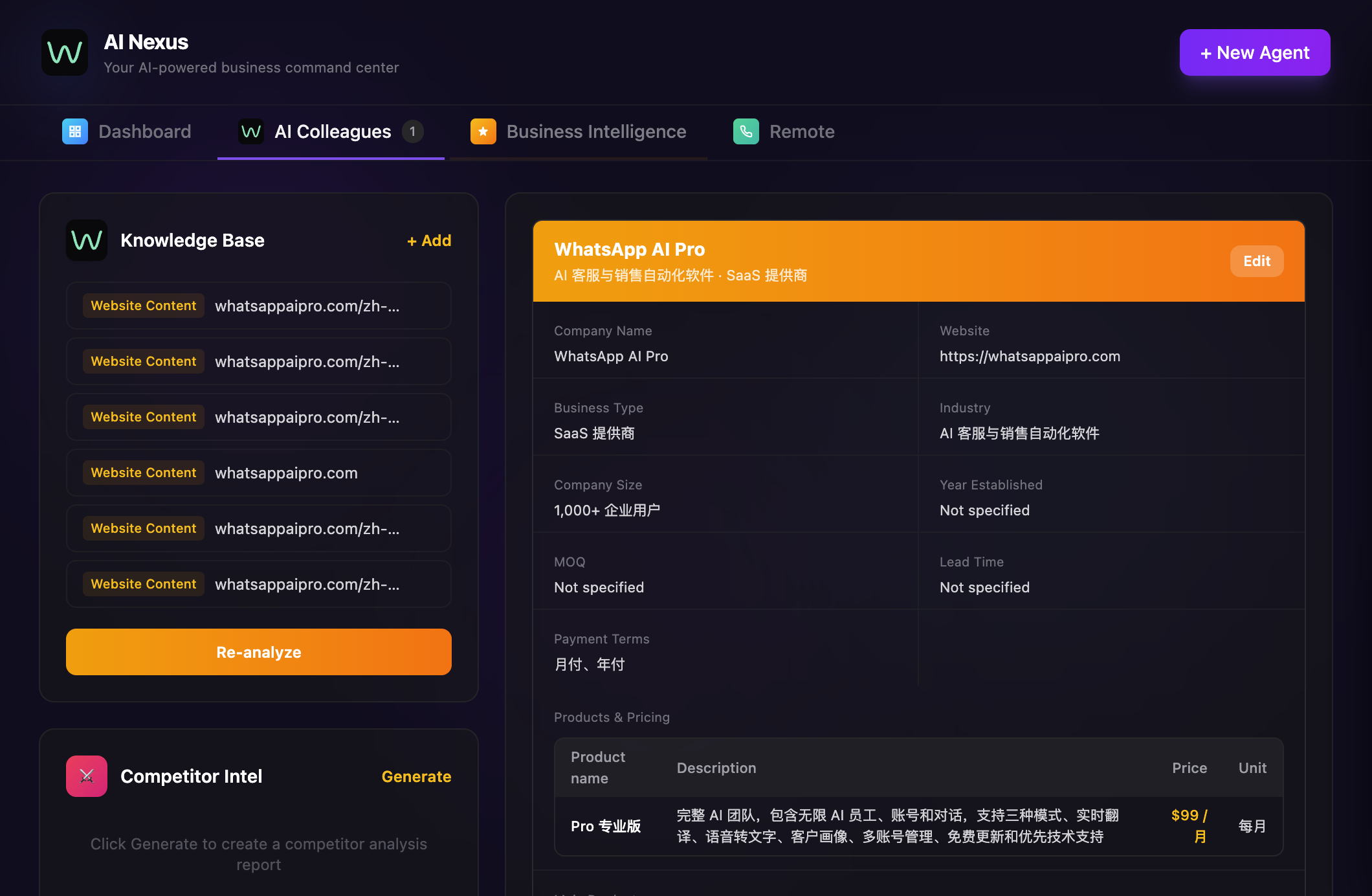
Step 1: Upload your company materials
Upload your product catalog, price lists, company profile, and core selling points to the AI knowledge base. The AI first learns who you are, what you sell, and where your advantages lie.
Then the AI does the rest: based on your company profile and industry positioning, it automatically searches the web for your competitors, analyzes their products, pricing, and positioning, and automatically generates a SWOT analysis — strengths, weaknesses, opportunities, threats. You don't need to manually enter each competitor.
The initial SWOT is a starting point. Review it. The AI might nail the broad strokes but miss nuances your sales team knows from experience. Like the fact that Competitor Y's lead times are technically 4 weeks but they're late 60% of the time. Or that Competitor Z's "premium" product uses the same components as their standard line. You can manually add that insider knowledge, and the SWOT gets sharper over time.
Step 2: Let it work in live conversations
Once set up, the AI recognizes when a customer mentions a competitor and pulls from your intelligence automatically. Instead of a vague "we have better quality" response, it builds a specific argument.
Say a customer writes: "Company X offers something similar at $2.80/unit. Why should I pay $3.50?"
Without competitive intelligence, the AI says something generic about quality. With it, the AI can point to the specific component difference, explain the practical impact, offer a volume discount if applicable, and ask if they'd like a comparison spec sheet. All within seconds.
The difference between a vague value claim and a specific, evidence-backed comparison is usually the difference between losing that deal and keeping it alive.
What you actually learn over time
The interesting part isn't the initial SWOT — it's what accumulates. Every customer conversation that mentions a competitor is data. After a few months you start seeing patterns:
- Which competitors come up most (and in which regions)
- Which objections are hardest to overcome
- Which of your competitive arguments actually work (customers who heard argument A converted at a higher rate than those who heard argument B)
- At what price point customers start mentioning alternatives
This feedback loop is the real value. The SWOT gets sharper. The AI's responses get more effective. Your worst salesperson starts responding to competitor questions the way your best salesperson would — because the AI has your best salesperson's knowledge baked in.
The speed thing
Worth mentioning: the moment a customer brings up a competitor is a high-stakes moment in the conversation. A fast, specific, confident response keeps things moving. A slow or vague response signals that you're not prepared — and the customer starts leaning toward the other option.
Your AI responds in seconds. No human is looking up competitive data, formulating a response, and typing it out that fast. In that specific moment, speed and specificity together are what keep the deal on your side.
Set it up once, keep feeding it what you learn, and let it handle the repetitive competitive conversations while you focus on the deals that need a human touch.
Download WhatsApp AI Pro — competitive intelligence included, 7-day money-back guarantee.